Beyond Chat: How AI Agents Are Taking Over Work in 2026

Remember when the novelty of AI was watching a robot write a poem about a cat? Those days are officially gone. In 2026, the question is no longer "Can AI write code?" or "Can it generate an image?" The question is: "Who is actually doing the work?" The answer, increasingly, is not you, nor is it a simple chatbot waiting for your next prompt. It is the AI agent.
The landscape of artificial intelligence has undergone a seismic shift. We have moved past the era of passive tools that wait for instructions and entered the age of autonomous execution. According to recent analyses of the AI tools landscape in 2026, the defining characteristic of this new era is the transition from simple chat interfaces to autonomous agents capable of executing complex, multi-step tasks [5]. This isn't just a software update; it is a fundamental restructuring of how work is defined, delegated, and completed.

As we navigate this new professional reality, it is crucial to understand not just what these tools are, but how they are changing the very fabric of employment, creativity, and productivity. Let’s dive deep into the world of AI agents, where the line between assistant and operator is blurring, and where the future of work looks less like a command line and more like a collaborative partnership with a digital entity that doesn’t sleep, doesn’t need coffee, and rarely makes the same mistake twice.
The Death of the "Copy-Paste" Era
For the past few years, the standard workflow for knowledge workers involved a tedious dance: prompt an LLM, copy the output, paste it into a document, edit it, copy that to an email, and so on. This was the "Chat Era." It was useful, but it was fundamentally a human-in-the-loop bottleneck. You were the glue holding the AI’s capabilities together.
In 2026, that glue is disappearing. AI agents are software applications that use artificial intelligence technology to solve problems and perform certain tasks, but with a critical difference: they have agency [1]. They don't just provide text; they provide results. If you ask a 2024 chatbot to "research the market for electric scooters in Southeast Asia," it might give you a list of links and a summary. If you ask a 2026 AI agent to do the same, it will likely scrape dozens of sites, cross-reference financial data, summarize the findings into a structured report, create a presentation slide deck, and email it to your boss—all while you are still sipping your morning coffee.
This shift represents a move from "generative" to "agentic" AI. The former generates content; the latter executes outcomes. The distinction is subtle but profound. It’s the difference between a calculator that tells you the answer and a mathematician who solves the entire equation for you, checks their work, and hands you the final proof.
Reasoning Models: The Brain Behind the Brawn
You might wonder: How do these agents avoid getting lost in the weeds? How do they know when they are making a mistake? The answer lies in the architecture of modern AI models. One of the dominant trends in 2026 is the integration of reasoning models that "think" before they respond [5].
These models utilize a process often described as "chain-of-thought" reasoning, where the AI breaks down a complex problem into smaller, manageable steps, evaluates each step, and then synthesizes the final action. This cognitive architecture has significantly reduced hallucination rates. According to benchmarks from OpenAI, these reasoning capabilities have reduced hallucination rates by up to 40% [5].
This is a game-changer for enterprise adoption. For years, businesses were hesitant to deploy AI in critical workflows because they feared the "confidently wrong" answer. If an AI agent is going to book a flight, transfer money, or update a database, it cannot afford to hallucinate. The rise of reasoning models has provided the reliability layer necessary for autonomy. It’s like moving from a junior employee who guesses when they don’t know the answer to a seasoned professional who pauses, thinks, and verifies before acting.
From Silos to Orchestration: The Multi-Agent Economy
Perhaps the most exciting development in 2026 is not the single, super-intelligent agent, but the multi-agent system. Imagine a digital team. One agent is the "Researcher," specialized in gathering data. Another is the "Writer," skilled in crafting narrative. A third is the "Analyst," focused on data interpretation. And a fourth is the "Manager," whose only job is to coordinate the other three, assign tasks, and ensure quality control.
These agents communicate with each other through structured protocols, sharing context and results without human intervention. This mirrors the way human teams operate, but with the speed and precision of code. In a typical workflow, a user might simply state a goal: "Prepare a quarterly report for the marketing department." The "Manager" agent then breaks this down, delegating data pulls to the "Researcher," drafting to the "Writer," and formatting to the "Analyst." The user receives a polished, comprehensive report without ever interacting with the individual components.
This orchestration capability is what allows AI to handle tasks that are too complex for a single prompt. It allows for parallel processing, where multiple aspects of a project are worked on simultaneously. It is the difference between one person trying to do everything and a well-oiled machine where each part performs its function perfectly.
The Democratization of Expertise
Historically, high-level strategy, coding, and design were the domain of specialists. You needed a developer to build an app, a data scientist to analyze trends, or a copywriter to craft a brand voice. AI agents are dismantling these barriers. One of the key trends in 2026 is the democratization of AI through low-code and no-code interfaces [5].
Today, a small business owner can use an AI agent to build a functional website, manage inventory, and run targeted ad campaigns without hiring a single technical specialist. A non-technical founder can instruct an agent to "build a prototype for a mobile app that tracks plant watering habits" and have a working version in hours. This is not just about saving money; it is about unlocking potential. It allows individuals and small teams to compete with large corporations by leveraging digital labor that scales infinitely.
This shift has profound cultural implications. It suggests that in the future, the value of an individual will lie less in their ability to execute specific technical tasks and more in their ability to define problems, set goals, and curate the output of AI agents. The "generalist" who can direct a team of specialized AI agents will have an advantage over the "specialist" who is limited to a single narrow skill set.
Case Study: The Autonomous Supply Chain
To understand the real-world impact of AI agents, let’s look at a concrete example: the supply chain. In the past, supply chain management was reactive. When a shipment was delayed, a human manager would notice, investigate, and call the vendor. This process was slow and error-prone.
In 2026, leading logistics companies use autonomous AI agents to manage supply chains proactively. These agents monitor thousands of data points in real-time: weather patterns, port congestion, supplier financial health, and demand forecasts. When an agent predicts a potential delay due to a storm in the Pacific, it doesn’t wait for a human to approve a change. It autonomously reroutes inventory to a different warehouse, updates the customer delivery estimates, and adjusts the production schedule at the factory. The human manager receives a summary of the actions taken and the reasons behind them, allowing them to focus on strategic exceptions rather than operational firefighting.
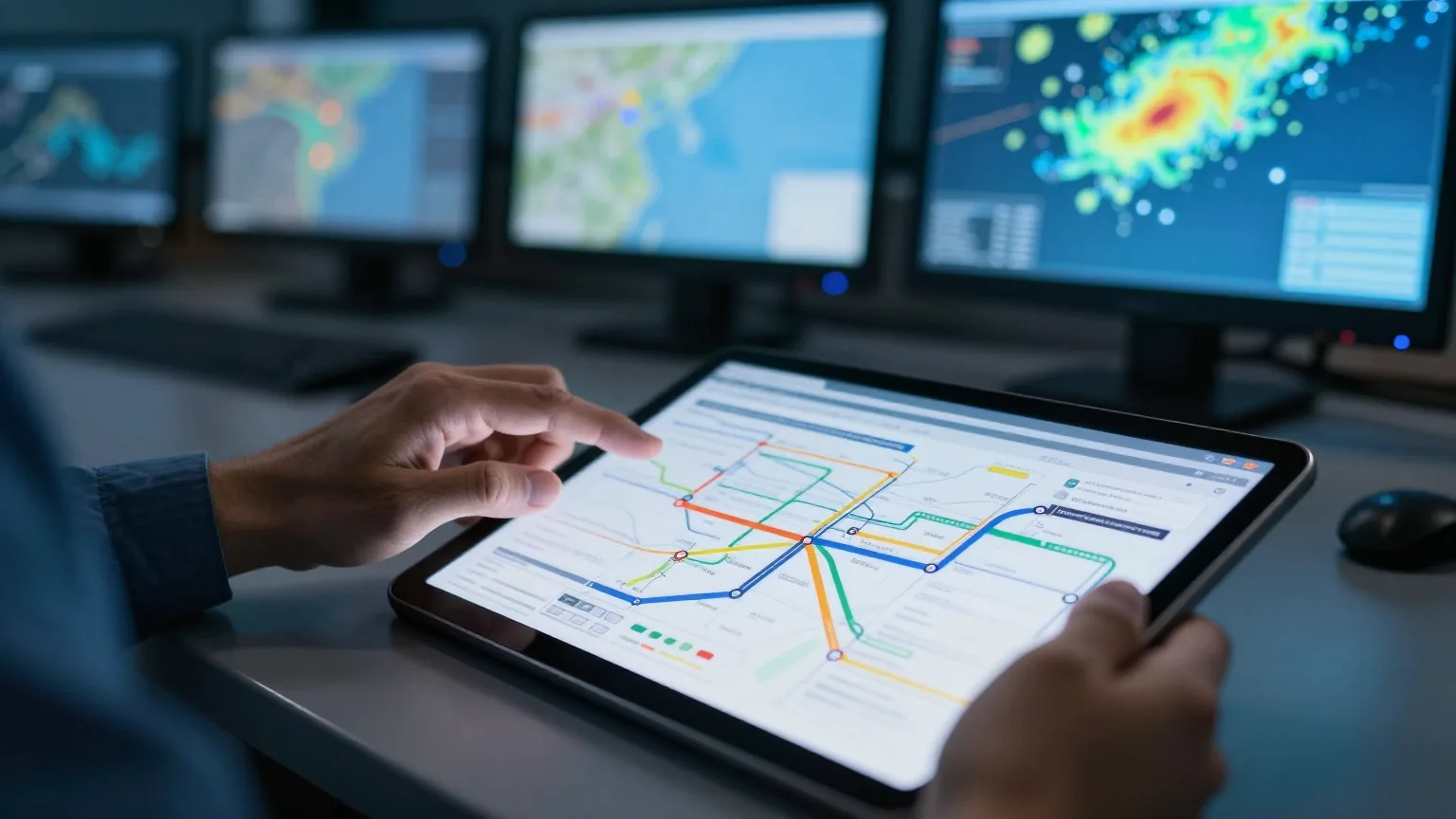
This is not science fiction; it is happening now. The result is a supply chain that is more resilient, efficient, and responsive than any human team could manage. It is a testament to the power of AI agents to handle the sheer volume and complexity of modern global logistics.
The New Skills for the Agent Era
If AI agents are taking over the "how," what happens to the "what" and the "why"? This is where the human role evolves. The skills required in the 2026 workplace are shifting. Technical proficiency is still valuable, but it is no longer the primary differentiator. Instead, three new skills are becoming essential:
- Prompt Engineering and Task Definition: The ability to clearly articulate complex goals and constraints to an AI agent. If you cannot clearly define the problem, the agent cannot solve it. This requires clarity of thought and communication skills.
- AI Auditing and Quality Control: While AI agents are highly reliable, they are not infallible. Humans must develop the skills to audit AI output, identify subtle errors, and ensure that the results align with ethical and business standards. This is the "editor" role, but for code, data, and strategy.
- Creative Direction and Strategy: AI can generate many options, but it cannot decide which one is best for your brand, your culture, or your long-term goals. Humans must provide the creative vision and strategic direction that guides the agents.
Think of it as moving from being a driver to being a navigator. The AI agent is the car, capable of driving itself. But you are still in the passenger seat, deciding where to go, watching the road for unexpected obstacles, and ensuring the journey is enjoyable. The driver is no longer the one holding the steering wheel, but the one holding the map.
Ethical Gray Areas and the "Black Box" Problem
As AI agents become more autonomous, they also become more opaque. When an AI agent makes a decision, it is often difficult for humans to understand exactly why. This is known as the "black box" problem. In 2026, this is a major concern for regulators and businesses alike.
If an AI agent denies a loan application, rejects a job candidate, or alters a medical treatment plan, how do we explain that decision? How do we ensure it was fair and unbiased? The rise of reasoning models helps, as they can provide a "chain of thought" explanation, but it is not a perfect solution. The logic of an AI is often probabilistic, not deterministic.
This has led to the emergence of "AI Ethics" as a distinct profession. Companies are hiring specialists to audit AI agents, ensure compliance with regulations, and develop frameworks for responsible AI deployment. It is a new layer of governance that did not exist a decade ago. It is a reminder that with great power comes great responsibility, and that autonomy must be balanced with accountability.
The Impact on Creative Industries
While AI agents are often associated with data and logistics, they are also transforming creative industries. In 2026, AI agents are not just generating images or text; they are managing entire creative pipelines. A film production company can use an AI agent to script a movie, generate concept art, storyboard scenes, and even edit the footage based on audience reaction data.
Does this mean the end of human creativity? Far from it. It means the beginning of a new era of creative collaboration. Human artists are using AI agents as "musical instruments" or "brushes" that can execute complex ideas with speed and precision. The human role shifts from "creator" to "curator" and "director." The question is no longer "Can I draw this?" but "What story do I want to tell, and how can I use AI to bring it to life in a way that is unique and compelling?"
This shift has sparked debate in the art world. Some argue that it devalues human labor; others argue that it expands the canvas of human expression. The truth, as with all technological shifts, is likely somewhere in between. The tools have changed, but the desire to create, to connect, and to express remains a core human drive.
Looking Ahead: The Next Frontier
As we look beyond 2026, the next frontier for AI agents is likely to be "embodied AI." This is the integration of AI agents with robotics, allowing them to interact with the physical world. Imagine an AI agent that not only manages your digital calendar but also books your restaurant reservation, packs your bag, and drives you to the airport. The boundary between digital and physical labor will continue to blur.
We are also seeing the rise of "personal AI agents"—digital avatars that represent you in meetings, negotiate on your behalf, and manage your personal life. These agents will learn your preferences, your communication style, and your goals, becoming true extensions of your identity. The concept of "self" may need to be redefined in a world where part of your cognitive and operational capacity is outsourced to a digital entity.
However, the most important aspect of this future is not the technology itself, but how we choose to use it. Will we use AI agents to increase inequality, concentrating power in the hands of a few? Or will we use them to democratize opportunity, allowing everyone to access the benefits of advanced technology? The choice is ours to make.
Conclusion: Embracing the Agent Era
The transition from chatbots to AI agents is not just a technological upgrade; it is a cultural and economic revolution. It challenges our assumptions about work, creativity, and intelligence. It forces us to ask difficult questions about the nature of human value in an age of machine autonomy.
But it also offers an incredible opportunity. For the first time in history, we have tools that can handle the mundane, the repetitive, and the complex, freeing us to focus on what makes us human: empathy, creativity, and strategic vision. The AI agent is not your replacement; it is your partner. It is the digital employee that never burns out, never gets bored, and always strives to improve.
So, how do you prepare for this future? Start by experimenting. Don’t wait for the perfect tool; start using the ones available today. Learn to define problems clearly. Learn to audit AI output. Learn to think like an orchestrator, not just an operator. The future of work is not about competing with AI; it’s about collaborating with it. The agents are ready. Are you?
Take the first step today. Identify one task in your workflow that is repetitive or complex, and see if an AI agent can handle it. You might be surprised by what you discover—and by what you free yourself to do next.