Gemini vs. OpenAI: How 2026's AI Tools Are Rewriting Work
Introduction: The Great AI Schism of 2026
It is late November 2026, and the hum of server farms is no longer a distant industrial buzz; it is the background radiation of modern life. If you are still thinking of artificial intelligence as a novelty or a chatbot for writing bad poetry, you are living in a different decade. Today, the debate is not about if AI will change your job, but how it is currently rewriting the rules of engagement in your specific industry.
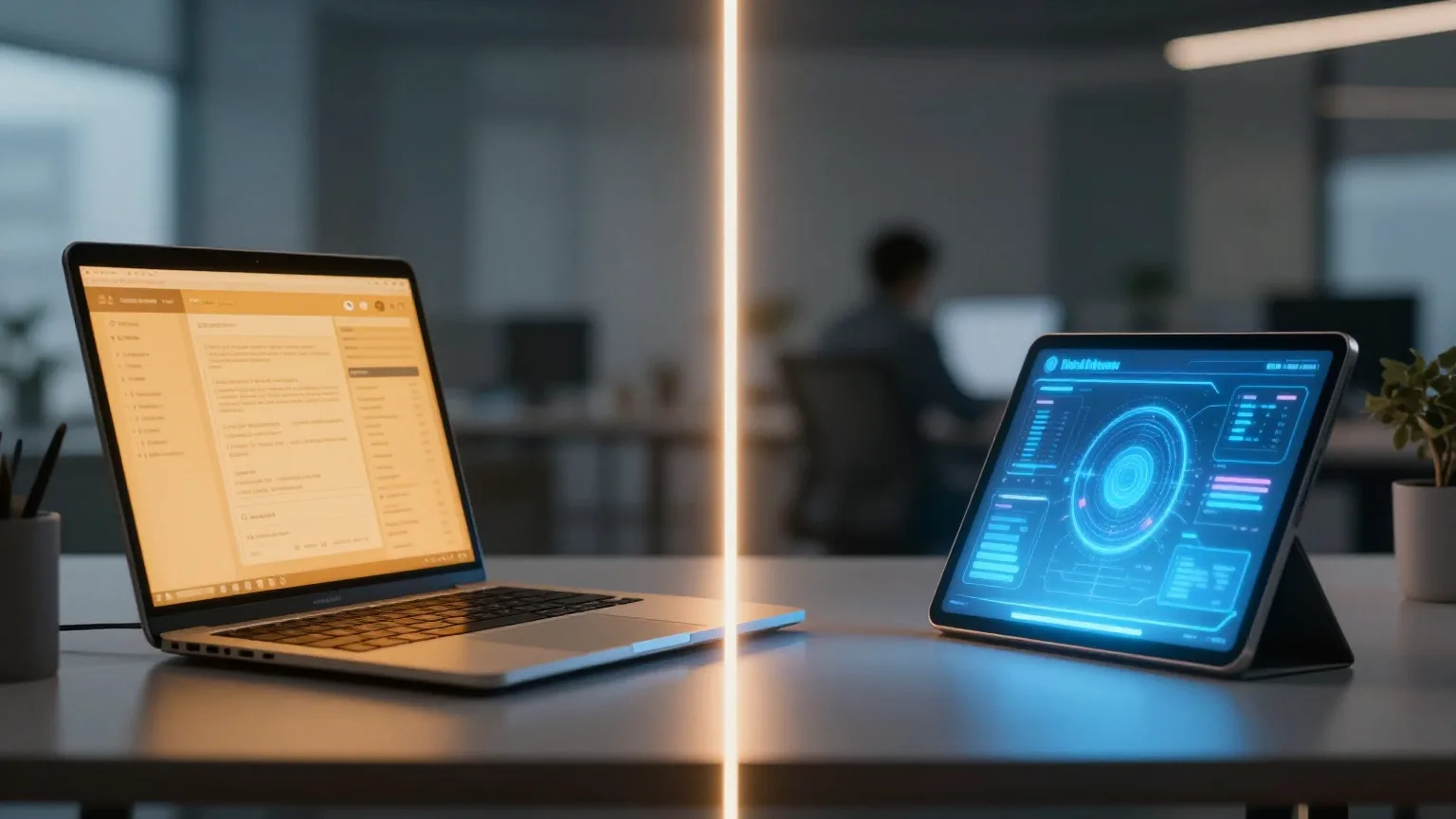
For the past few years, the narrative has been dominated by a binary struggle: the open versus the closed, the experimental versus the enterprise. But by 2026, that binary has dissolved into a complex ecosystem of specialized tools, each vying for a slice of the cognitive labor pie. At the center of this storm are two titans: OpenAI and Google. These are not just companies; they are the architects of the new digital workplace. One is pushing toward a singular, general intelligence, while the other is weaving its AI into the fabric of every device and service you already own.

This post isn't just a comparison of features. It’s a deep dive into how these two distinct philosophies are reshaping the way we work, creating, and solve problems. We will explore the "AGI" promise versus the "Ubiquitous" reality, and look at what this means for you, the knowledge worker navigating this new terrain.
The Two Philosophies: General Intelligence vs. Ubiquitous Integration
To understand the Gemini vs. OpenAI dynamic in 2026, we first have to look at their founding myths and current trajectories. OpenAI has always been the visionary startup. Their mission statement is bold and almost philosophical: they believe their research will eventually lead to artificial general intelligence (AGI), a system that can solve human-level problems [1]. This is the "Moonshot" approach. It’s about building a brain that can think, reason, and adapt to any task, much like a human, but without the biological limitations.
Google, on the other hand, has historically been the "Plumber." They don't just want to build a brain; they want to build the nervous system of the internet. Gemini, Google’s AI assistant, is designed to get help with writing, planning, brainstorming, and more, but it does so by leveraging the vast, interconnected web of Google’s existing services [5]. Where OpenAI builds a standalone entity that you interact with, Google builds an entity that interacts with you through the tools you already use—Email, Docs, Search, and Android.
This distinction is crucial. OpenAI is building a new kind of employee. Google is upgrading the existing office. In 2026, this means that if you are a developer, a marketer, or a data analyst, your workflow is likely split between these two ecosystems. You might use OpenAI’s models for deep, complex reasoning and code generation, while relying on Gemini for seamless integration into your daily administrative tasks.
What is AI, Really? A 2026 Definition
It is easy to get lost in the acronyms, so let’s ground ourselves in the definition. According to IBM, Artificial Intelligence (AI) is technology that enables computers and machines to simulate human learning, comprehension, problem solving, decision-making, creativity, and autonomy [3]. In 2026, this definition feels almost quaintly modest. We have moved beyond simple simulation into active collaboration.
The "creativity" and "autonomy" parts of that definition are the ones that keep CEOs up at night and keep creative professionals up at night (for different reasons). In 2020, AI was a calculator. In 2023, it was a writer. In 2026, it is a colleague. It doesn't just answer questions; it anticipates needs. It doesn't just generate text; it generates workflows. The technology has matured to the point where the line between human intent and machine execution is blurring. We are no longer just using AI; we are co-creating with it.
The OpenAI Ecosystem: The Power of Depth
Let’s zoom in on the OpenAI side of the house. By late 2026, the OpenAI ecosystem has evolved far beyond a simple chat interface. It has become a platform for high-stakes cognitive labor. The focus here is on depth. If you have a problem that requires multi-step reasoning, complex code architecture, or nuanced strategic analysis, the OpenAI tools are often the go-to choice.
The promise of AGI [1] has driven a race to build models that can handle longer contexts and more complex logical chains. In practical terms, this means that an OpenAI-powered tool can ingest a 200-page legal contract, a stack of financial reports, and a set of customer feedback logs, and then synthesize a risk assessment that a human team would take weeks to produce. This is the "Deep Work" use case. It’s for the tasks that require sustained focus and high-level abstraction.
However, this depth comes with a cost. The OpenAI tools often require a higher degree of user expertise. You need to know how to prompt effectively, how to structure your data, and how to interpret the outputs critically. It is a powerful engine, but it requires a skilled driver. In 2026, "Prompt Engineering" has evolved into "AI Orchestration," a specialized skill set that is becoming as important as coding or writing in many industries.
The Google Gemini Ecosystem: The Power of Breadth
Contrast this with the Google Gemini experience. Gemini is less about being a standalone genius and more about being a helpful companion that is always there [5]. The strength of Gemini lies in its integration. Because Google controls the search engine, the email client, the cloud storage, and the mobile operating system, Gemini can see the context of your entire digital life (with your permission, of course).
Imagine you are preparing for a client meeting. With a standalone AI, you have to copy and paste your emails, your calendar invites, and your previous notes into the chat window. With Gemini, the AI can already see those items. It can draft the agenda, flag the conflicting schedules, and even suggest talking points based on the tone of your last three emails with that client. This is "Ubiquitous AI." It’s less flashy, but it’s incredibly efficient. It removes the friction of data transfer. It makes the AI invisible, or at least, frictionless.
In 2026, this has led to a phenomenon known as "Ambient Intelligence." The AI is not something you open; it is something that is always running in the background, ready to assist. For many users, this is the preferred experience because it aligns with how they already work. They don’t want a new tab; they want their existing tabs to be smarter.
Workplace Integration: How the Tools Actually Fit In
So, how do these two approaches manifest in the daily grind? Let’s look at a few common job roles.
For Software Developers: The OpenAI models are often preferred for building complex algorithms or debugging intricate codebases. The ability to understand large code repositories and suggest refactoring strategies is a key advantage. Google, on the other hand, has integrated AI deeply into its development tools, like GitHub Copilot (which has evolved significantly) and its own coding assistants. The difference is subtle: OpenAI is better at the "hard" problems, while Google’s tools are better at the "fast" problems, like boilerplate code and documentation generation.
For Marketers and Content Creators: Here, the split is even more pronounced. OpenAI is used for strategic brainstorming and long-form content creation. You might use it to develop a new brand voice or to analyze market trends. Gemini, however, is the workhorse for distribution. It can automatically generate social media captions based on your blog posts, optimize ad copy for different platforms, and even analyze engagement metrics to suggest adjustments. The workflow is seamless: Create with OpenAI, Distribute with Gemini.
For Data Analysts: This is where the battle is most intense. OpenAI’s models can write Python or SQL code to analyze data, but they often require the user to provide the data in a specific format. Gemini, integrated with Google Sheets and BigQuery, can analyze data directly within the spreadsheet. You can ask, "Why did sales drop in Q3?" and it can pull the data, run the analysis, and generate a chart, all without you leaving the sheet. For most business users, this is a game-changer. It democratizes data analysis.
The Economic Impact: Productivity vs. Displacement
As these tools become more integrated, the economic implications are becoming clearer. The primary argument for AI in the workplace is productivity. By automating routine tasks, employees can focus on higher-value work. A study from 2025 suggested that companies using AI tools saw a 20-30% increase in productivity in targeted roles [2]. By 2026, these numbers have likely stabilized, but the impact has broadened.
However, the flip side is displacement. Jobs that were previously safe—like data entry, basic copywriting, and junior-level coding—are now at risk. The "Junior" role is becoming the "AI Manager" role. Instead of doing the work, you are directing the AI to do the work. This has created a new skill gap. Companies are now looking for candidates who can effectively use AI tools, not just those who have traditional skills.

This has led to a cultural shift in hiring. Resumes now include "AI Proficiency" sections. Interviews include practical exercises where candidates must use an AI tool to solve a problem. The ability to collaborate with AI is becoming a core competency, much like Excel was in the 2000s.
Cultural and Historical Context: From Babbage to Bots
It is helpful to step back and look at the history of automation. Every major technological shift has faced similar resistance. The Luddites smashed looms in the 19th century because they feared the machines would take their jobs. In the 20th century, the introduction of computers in the office sparked fears that clerks would become obsolete. History suggests that technology does not eliminate work; it transforms it.
The current shift is no different. The "white-collar" jobs of the 21st century are being transformed by AI. The historical parallel is the shift from manual labor to cognitive labor. Just as machines took over physical tasks, AI is taking over routine cognitive tasks. The human role is shifting toward oversight, strategy, and creativity. We are moving from a world where humans do the work and machines assist, to a world where machines do the work and humans direct.
This cultural shift is not without its challenges. There is a growing anxiety about the loss of "craft." If an AI can write a novel in minutes, what is the value of a human novelist? If an AI can design a building in hours, what is the value of an architect? The answer, increasingly, is that the value lies in the human perspective, the emotional connection, and the ethical judgment that AI cannot replicate. The tools are powerful, but they are not wise. They are not kind. They are not accountable. Those are human traits, and they are becoming more valuable, not less.
Privacy and Security: The New Frontier
As we integrate AI into our work, we must address the elephant in the room: privacy. When you use a cloud-based AI tool, your data is often processed on servers. For OpenAI, this means your prompts and outputs are sent to their servers for processing. For Google, it means your data is potentially mixed with your other Google data, such as search history and email.
In 2026, this has become a major concern for businesses and individuals alike. There are new regulations, such as the EU’s AI Act, which require companies to be transparent about how they use data. Many enterprises are now using "on-premise" AI models, where the AI runs on their own servers, ensuring that data never leaves their network. This is a significant shift from the cloud-first model of the early 2020s.
However, on-premise models are often less powerful than their cloud-based counterparts. This creates a trade-off: security versus capability. Many organizations are adopting a hybrid approach, using cloud AI for non-sensitive tasks and on-premise AI for sensitive data. This complexity requires a new level of IT management, further emphasizing the need for skilled professionals who understand both AI and cybersecurity.
The Ethical Dilemma: Bias, Bias, and More Bias
AI models are only as good as the data they are trained on. If the data contains biases, the AI will perpetuate them. In 2026, this is a major issue. AI tools have been found to exhibit biases in hiring, lending, and even criminal justice. For example, an AI tool used to screen resumes might favor candidates from certain universities or backgrounds, not because it is "smart," but because that is what it learned from historical data.
This has led to a new field: AI Ethics. Companies are now hiring "AI Ethicists" to audit their models for bias and fairness. It is a challenging role, as it requires both technical expertise and a deep understanding of social justice. The goal is to ensure that AI tools are not just efficient, but also fair. This is not just a moral imperative; it is a legal one. Companies that use biased AI tools are facing lawsuits and regulatory fines.
The challenge is that bias is often subtle. It’s not always obvious that an AI is discriminating. It might be that the AI is simply reflecting the status quo. The solution is not to throw the baby out with the bathwater, but to carefully curate the data and to continuously monitor the outputs. It is an ongoing process, not a one-time fix.
Future Outlook: What’s Next for 2027?
As we look toward the end of 2026, it is clear that the AI revolution is still in its early stages. The next few years will likely bring even more integration and specialization. We can expect to see:
- Multi-Modal AI: AI that can seamlessly switch between text, image, audio, and video. Imagine a meeting where the AI not only transcribes the conversation but also analyzes the speaker’s tone, body language, and even the slides they are presenting.
- Agentic AI: AI that can take on entire projects, not just tasks. Instead of asking an AI to "write an email," you ask it to "handle the client onboarding process," and it manages the entire workflow, from sending the welcome email to setting up the account.
- Personalized AI: AI that learns your specific preferences and style. Your AI assistant will know that you prefer concise emails, that you hate unnecessary jargon, and that you always double-check your facts. It will become a true digital twin of your work style.
The competition between OpenAI and Google will continue to drive innovation. OpenAI will likely push the boundaries of AGI, creating models that can solve problems we haven’t even thought of yet. Google will likely deepen its integration, making AI so ubiquitous that it becomes invisible. The winner is not one or the other; it is the user who can leverage both.
Conclusion: Embracing the Co-Pilot Era
The story of 2026 is not about humans versus machines. It is about humans with machines. The tools are powerful, but they are only as good as the people who use them. The key to success in this new era is not to resist AI, but to master it. Learn how to prompt. Learn how to integrate. Learn how to audit. Learn how to collaborate.
Whether you choose the depth of OpenAI or the breadth of Google, the goal is the same: to augment your human capabilities, not replace them. The future of work is not about being replaced by AI; it is about being enhanced by it. The question is not whether AI will change your job, but whether you will change your job to accommodate AI.
The train is leaving the station. You can watch it from the platform, or you can board it. The choice is yours. But know this: the view from the front of the train is a lot more interesting than the view from the platform.
Call to Action
Ready to take the first step? Here is your challenge for the next 30 days:
- Audit Your Workflow: Identify three tasks you do every week that are repetitive and rule-based. These are your candidates for automation.
- Test Both Tools: Spend a week using an OpenAI-based tool for a complex task. Spend another week using a Gemini-integrated tool for a routine task. Compare the results.
- Learn the Language: Read one article about AI ethics or AI security. Understand the risks as well as the benefits.
- Share Your Insights: Talk to your colleagues about your experience. Is your team ready for this? What are the barriers? What are the opportunities?
The future is not something that happens to us. It is something we create. Let’s create it wisely.